Shutters for Arched, Round and Awkward Windows
How custom shutters are made for arches, angles and awkward openings, and why these jobs need a specialist who measures on site.
The short answer
Arched, round, angled and gable windows are shuttered with fixed sunburst or custom-shaped panels, cut individually to the exact geometry rather than pulled off a standard size chart. They cost more than a rectangular window of the same area because every angle is templated, framed and finished by hand, so expect a complexity uplift of roughly 20 to 40 percent. The only accurate figure is a free measured quote from a specialist who has fitted the shape before.
Not every window is a neat rectangle, and the awkward ones are usually the ones that make a room. An arched hallway window, a round porthole in a gable, a raked panel following a cathedral ceiling: these are the openings that flat-pack blinds and off-the-shelf shutters simply cannot cover cleanly. This is where custom made-to-measure shutters do their best work, because each panel is built to the exact shape of the hole in your wall. This guide covers the main awkward window types, how they are shuttered, what the shape costs you, the Adelaide-specific traps in older homes, and how to turn a rough range into a firm figure.
The awkward windows shutters actually solve
Almost any shape can be shuttered, but each type is handled differently. Knowing which approach applies to your window sets a realistic expectation before a specialist ever measures. If your awkward opening is a bay or a run of angled facets, the sibling guide to plantation shutters for bay windows and angled openings goes deeper on that specific shape, and the room-by-room estimator lets you sketch out a whole home before you commit.
| Window shape | Usual shutter approach | Operable? |
|---|---|---|
| Arched / half-round top | Fixed sunburst arch above, operable panels below | Lower half tilts, arch is fixed |
| Full circle / porthole | Fixed sunburst or fixed louvre round | Usually fixed |
| Angled / raked (gable, cathedral) | Custom-cut frame following the rake | Operable louvres, angled top rail |
| Triangle / apex | Fixed shaped panel, no tilt rod | Fixed |
| Tall narrow / feature slot | Single narrow panel, mid rail for stability | Fully operable |
The pattern is simple: the more a window departs from a rectangle, the more likely the shaped section is fixed rather than tilting. A half-round arch over a standard window is the common Adelaide case, and the honest trade-off is that you get the shape and the light control on the working half, while the arch itself becomes a permanent architectural feature.
Why shape adds to the price
A rectangular shutter is cut from standard stock to standard sizes. An arch or a rake is not. Every awkward window is templated on site, often with a physical pattern traced against the glass, then the frame and louvres are cut and finished to match that one opening. That extra labour is the uplift, and it is real work, not a markup.
- Templating. A curved or angled opening needs a physical or digital template, not just 2 numbers off a tape.
- Bespoke framing. The frame is mitred and joined to the exact angle, which cannot be batched with square jobs.
- Fixed sunburst work. The radiating louvres in an arch or round are set by hand, one of the most skilled parts of the trade.
- Waste and risk. A mis-cut on a shaped panel is expensive, so specialists price in the care the shape demands.
As a rough guide, a shaped or angled window carries a complexity uplift of about 20 to 40 percent over a rectangle of the same area. On a single arched hallway window that might mean $650 to $950 rather than the $450 to $700 a plain window of that size would run. Those figures are indicative only. A free measured quote is the sole way to price your exact opening, because the degree of curve and the depth of reveal move the number more than anything else.
The Adelaide-specific traps in older homes
Adelaide has a lot of the exact housing stock where awkward windows live: bluestone villas in Unley and Norwood, sandstone cottages in Prospect, and 1920s bungalows across Mitcham and Hyde Park with arched entry windows and gable feature glass. Two things about these homes catch people out.
First, heritage arches are rarely symmetrical. A century of settlement means the left of the curve often differs from the right by several millimetres, so a shutter templated to the true shape looks square while a shutter cut to an assumed radius looks visibly off. This is the single biggest reason a shaped window needs a specialist who fits the shape regularly, not a generalist working from a photo. The cornerstone guide on how to choose a plantation shutter installer in Adelaide covers exactly what to check before you let anyone template a heritage opening.
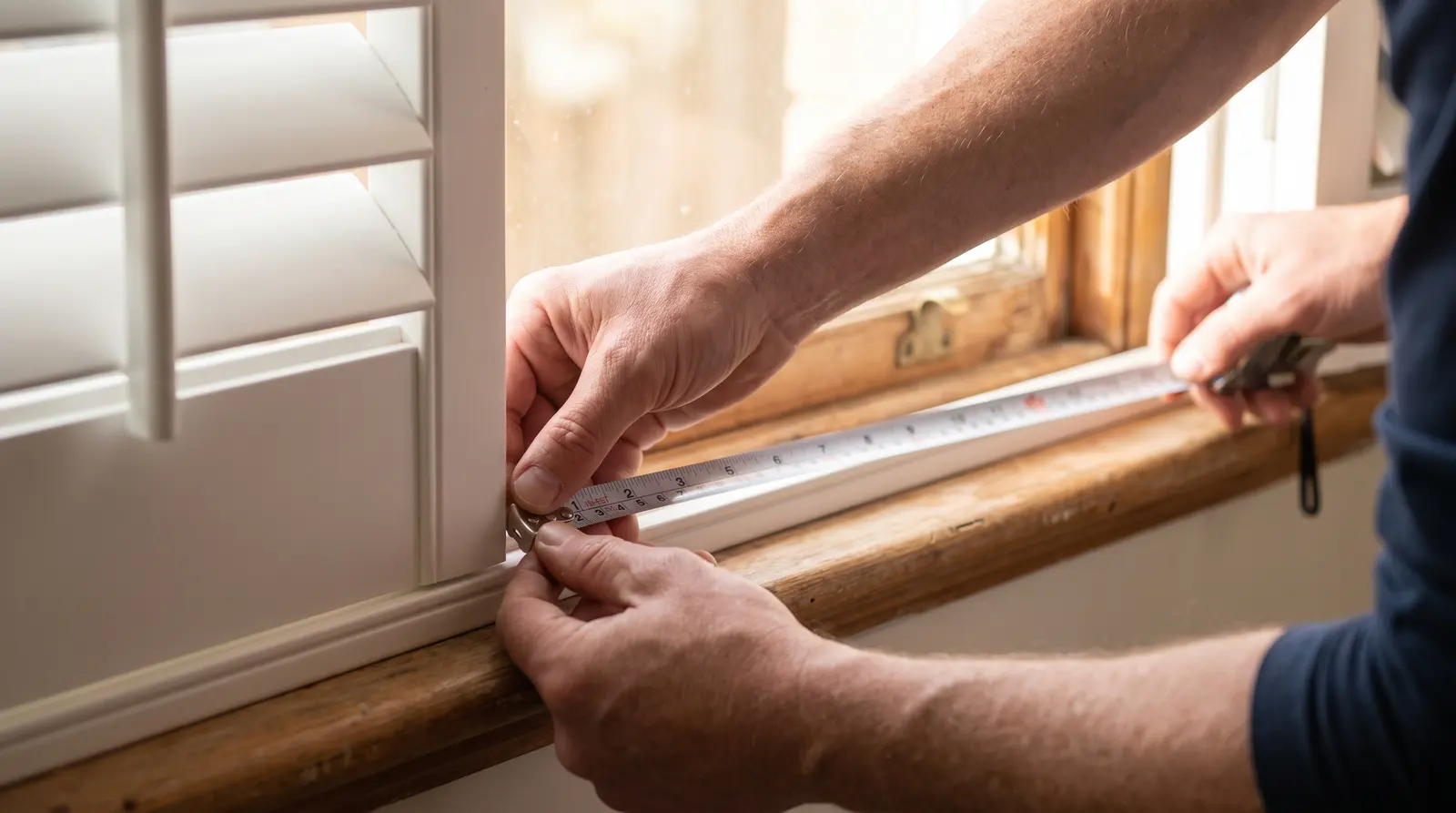
Second, deep stone reveals. Many older Adelaide homes have reveals 200mm or deeper, which changes whether a shaped panel mounts inside the reveal or on a build-out frame across the face. That decision affects both the look and the price, and it is one a tape measure in inexperienced hands gets wrong. It is also why measuring for plantation shutters is a job for a pro, especially on anything that is not a clean rectangle.
Heritage-listed and character-overlay homes carry their own rules on what you can change to a street-facing window. Before altering a period opening it is worth checking the guidance on South Australian heritage properties and, for the fair-trading side of any home-improvement contract, South Australia’s Consumer and Business Services.
Do awkward shutters still control light and heat?
Yes, and this is the part homeowners underestimate. A fixed sunburst arch is not just decorative. West-facing arched and gable windows are notorious heat gain points in an Adelaide summer, and a fixed shaped panel with closed louvres blocks a large share of that direct sun while a bare feature window bakes the room. Timber and basswood shutters add a genuine insulating air layer against the glass, which the Australian Government’s Your Home guide rates as one of the more effective low-tech ways to manage a hot room. On an operable lower panel you keep full tilt control for privacy and glare, so the awkward window stops being the one you hang a sheet over in February.
How to turn a range into a firm price
A range only becomes a number after a measure, and that is doubly true for a shape. A specialist visits, templates the exact curve or angle, confirms whether the shaped section is fixed or operable, decides the mount against your reveal, and prices the real job. That measure is free and carries no obligation. The smart move on an awkward window is to get 3 of them, so you can compare not just the price but who genuinely understands the shape, because a specialist who fits arches every week is a different proposition to one who rarely sees them.
This service gets you started. We do not sell your details to a call centre. We pass your enquiry to a local specialist who covers your suburb and fits shaped and custom windows, then you choose with confidence.
The bottom line
Arched, round, angled and gable windows are all shutterable, usually with a fixed shaped panel on the awkward section and operable louvres where they earn their keep. Budget on a 20 to 40 percent uplift over a plain window of the same size, insist on a specialist who templates the true shape rather than an assumed one, and get it measured before you trust any figure. The fastest way to a real price is to get a free quote on custom made-to-measure shutters, each one costing you nothing and replacing every range on this page with a firm number for your exact windows.