How to Measure for Plantation Shutters (and Why a Pro Should)
How plantation shutters are measured, why millimetres matter, and why a professional measure is included free in a proper quote.
The short answer
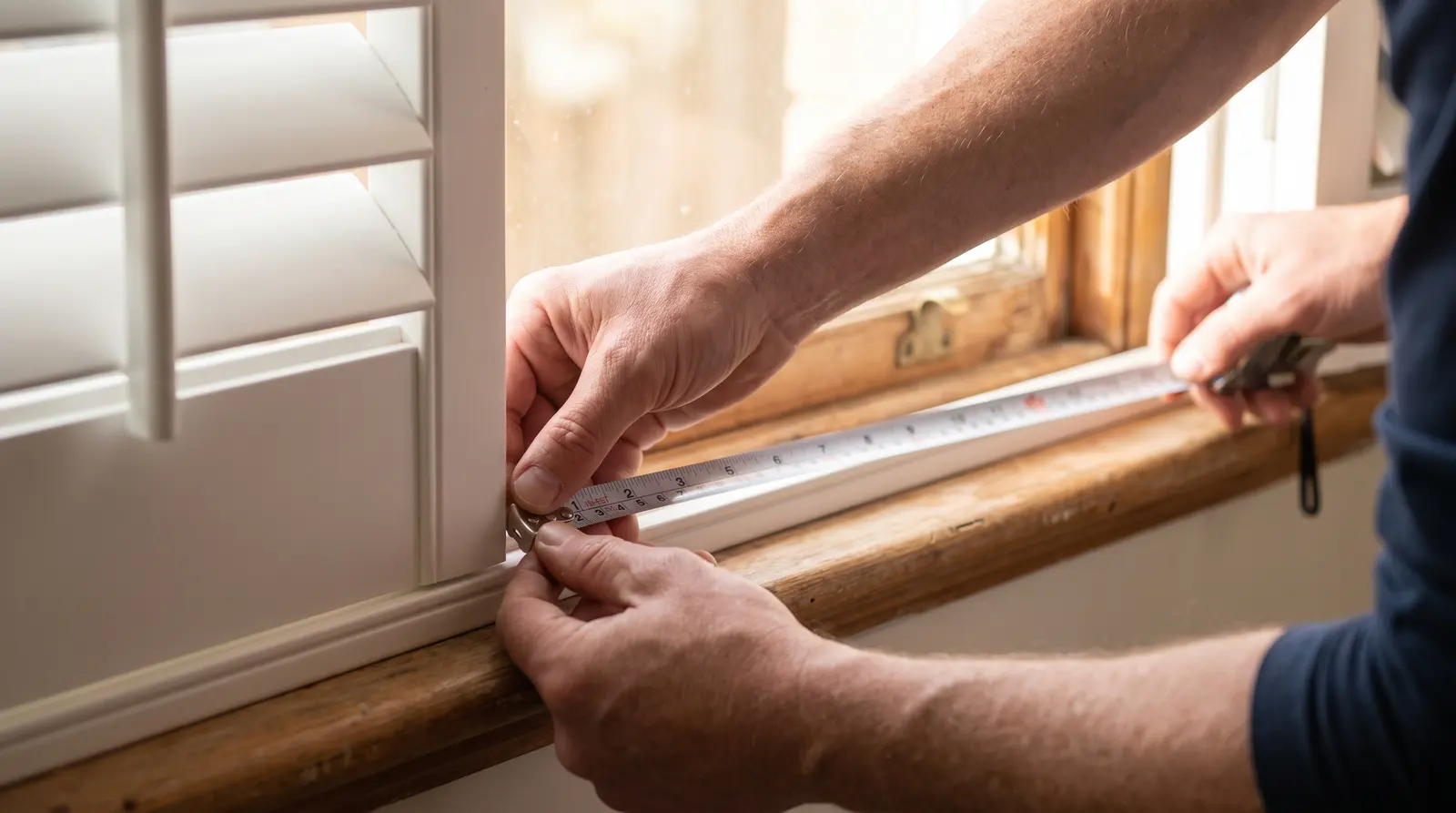
To measure for plantation shutters, decide inside or outside mount first, then use a steel tape to measure the width in 3 places and the height in 3 places, recording the smallest reading each time to the nearest millimetre. For an inside (recess) mount you also check the reveal depth so the frame and louvres clear the glass. It sounds simple, but a shutter is machined to a tolerance of about 3mm, so the accurate figure that actually goes into production is the one a specialist takes at a free measure, not a DIY tape reading.
Measuring is the step where a shutter job is won or lost. Every panel is cut to your exact opening, so a reading that is 5mm out does not get trimmed on site the way a curtain does: it comes back wrong and has to be remade. This guide shows how the measure is actually done so you understand your quote, but the honest position is that the number which goes to the factory should be taken by the person who carries the warranty. That is why custom made-to-measure shutters are quoted from a professional measure, and it is also why we match you with local specialists rather than leaving you to measure your own home. If you want a rough size for budgeting first, the room-by-room estimator turns your window count into an indicative figure, and How to Choose a Plantation Shutter Installer in Adelaide covers who should be taking that measure in the first place.
Decide inside or outside mount before you touch the tape
The single decision that changes every measurement is where the shutter sits. An inside (or recess) mount fits the frame within the window reveal for a clean, built-in look. An outside mount sits the frame on the wall or architrave around the opening, which suits shallow reveals and hides an out-of-square window. You cannot measure sensibly until this is settled, because the two are measured to different reference points. Our full breakdown of inside versus outside mount plantation shutters walks through which one suits your windows. For an inside mount, the reveal also has to be deep enough: allow roughly 60mm to 90mm of clear depth for the frame and louvre swing, and less than that usually means a build-out frame, which a specialist spots on sight.
How to measure the width and height
Use a steel tape, never a fabric one, and work in millimetres. Windows are almost never perfectly square, especially in older Adelaide homes, so you take multiple readings and let the opening tell you the truth.
- Width, 3 places. Measure the opening at the top, middle and bottom. For an inside mount, record the smallest of the 3 so the frame fits the tightest point. For an outside mount, measure the full opening and add your chosen overlap on each side.
- Height, 3 places. Measure the left, centre and right. Again, take the smallest for a recess fit; for an outside mount, measure to where the frame will finish top and bottom.
- Reveal depth, 4 corners. On an inside mount, measure how deep the reveal is at each corner so the frame and blades clear the glass, handles and any window winders.
- Note the obstructions. Locks, handles, tiled sills, meter boxes and skirting all affect the frame and are exactly what a DIY tape reading misses.
Write every figure as width by height, in that order, and label the room. A number without a room name is how the wrong panel ends up on the wrong window.
The mistakes that turn into a remake
A shutter is manufactured to a tolerance of around 3mm, which leaves no room for the common errors. The ones that cost money are measuring with a soft tape, taking a single reading and assuming the window is square, confusing width and height, forgetting to allow for the mount type, and ignoring a tiled or rendered sill that eats into the reveal. There is also the trap of measuring the existing curtain or blind rather than the actual opening. None of these get caught until the panels arrive, and a remade set is time and money you do not get back. This is the core reason a free professional measure is not an upsell: it transfers the risk of a wrong number away from you and onto the specialist who has to guarantee the fit.
Angled, arched and bay windows are a different job
Standard rectangular windows are the easy case. The moment an opening is angled, arched, a raked gable end or a bay, the measure stops being 3 readings and becomes a template exercise with mitre angles and hinge planning. A bay window alone needs the angle between each facet measured precisely, because the frames meet at custom mitres rather than 90 degrees. This is firmly specialist territory, and our guide to plantation shutters for bay windows and angled openings shows why. If your home has any of these, treat DIY measuring as a way to understand the job for your own budgeting, not as the figure that goes into production.
An Adelaide example: the 3mm heritage reveal
Here is a real-world illustration of why the tolerance matters. Take a typical 1920s bungalow in a suburb like Unley or Prospect, where the original timber window reveals were rarely built square. Measure the width of one opening at the top and you might get 902mm; measure the bottom of the same window and you get 896mm. That 6mm difference is invisible to the eye and completely normal for a heritage home, but it decides the panel size: build to 902mm and the shutter jams at the sill, build to 896mm and you fit cleanly with the standard clearance. A homeowner with a tape reads one number and orders wrong; a specialist reads all 3 and orders right. Multiply that across 12 windows in an older home and DIY measuring stops looking like a saving.
Why the accurate measure should come from a pro
A professional measure is more than a tape. The specialist confirms the mount, checks the reveal is deep and square enough, allows for handles and winders, notes whether a build-out frame is needed, and takes on the warranty for that fit. It is free and carries no obligation, and it is the only figure precise enough to manufacture from. It also protects you as a consumer, because the person measuring is the person accountable if it is wrong. For general guidance on choosing and comparing tradespeople, South Australia’s Consumer and Business Services covers licensing and fair trading, the ACCC consumer resources explain your rights on made-to-order goods, and Your Home (the national guide to sustainable homes) covers how well-fitted window coverings improve thermal comfort, which a sloppy measure undermines.
The bottom line
Measure inside or outside mount first, use a steel tape, take 3 width and 3 height readings plus the reveal depth, and record the smallest to the millimetre. Do that to understand your job and sanity-check a quote. Then let a specialist take the measure that goes into production, because a 3mm tolerance and an out-of-square Adelaide window leave no margin for a DIY guess. The smart move is to get measured quotes and compare. This service gets you started: share your windows, we pass your enquiry to a local specialist who covers your suburb, and you choose with confidence. Start with a free measured quote on custom made-to-measure shutters and let the tape work be someone else’s responsibility.