Plantation Shutters and Energy Efficiency
How plantation shutters improve energy efficiency in Adelaide homes year round, and how they compare to blinds and curtains.
The short answer
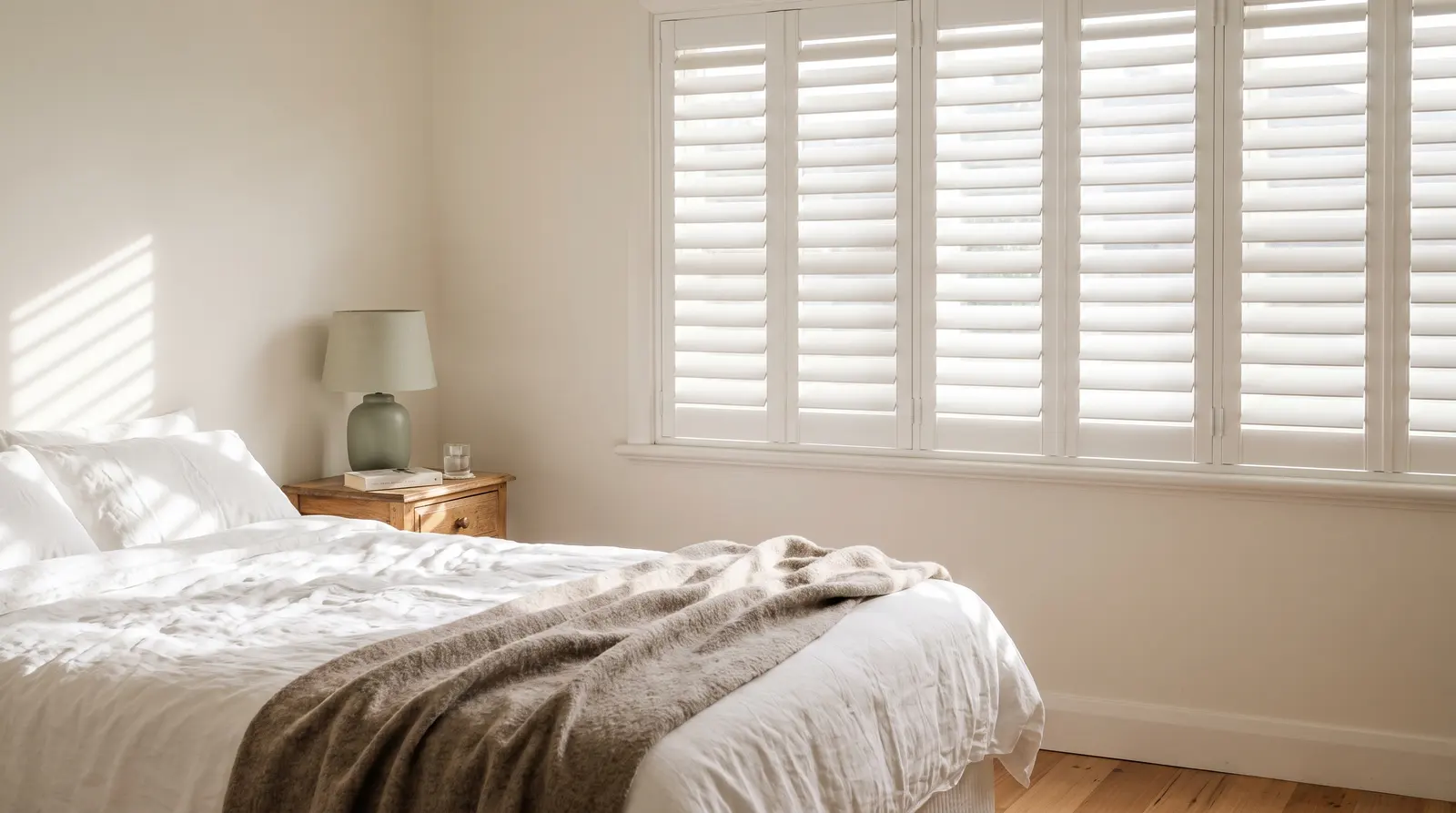
Plantation shutters improve a home’s energy efficiency by adding a still-air barrier at the glass, where most heat is lost in winter and gained in summer. In an Adelaide climate that swings from 40-degree February afternoons to single-digit July mornings, closed louvres steady a room and take load off the air conditioner. They are not a substitute for double glazing, but they are the cheapest efficiency upgrade you can make to a window you already own.
Windows are the weak point in almost every Adelaide home. Australian Government guidance is blunt about it: in an uninsulated house, windows can be responsible for up to 87 percent of summer heat gain and up to 40 percent of winter heat loss, according to Your Home, the national guide to sustainable homes. A closed shutter sits directly across that weak point, which is why quality indoor shutters earn their place as an efficiency measure and not just a good-looking one. This guide covers how the physics actually works, which material insulates best, and where in an Adelaide house a shutter pays for itself fastest.
How a shutter actually saves energy
A shutter does not insulate the way batts in a ceiling do. It works by trapping a layer of still air between the louvres and the glass and by cutting the radiant heat that pours through a bare window. On a west-facing Fulham or Glenelg living room in January, closing the louvres before the afternoon sun hits stops a large share of that heat load before it ever enters the room, so the air conditioner is fighting a smaller battle. In winter the same barrier slows the warmth escaping back out through cold glass overnight. The effect is real but bounded: a shutter steadies a room and trims your peak cooling and heating demand, it does not turn a single-glazed window into a wall. To see how that plays out room by room across a whole house, the room-by-room estimator lets you map material and window count against each space. Bedrooms are usually the first place people notice the difference, which is covered in detail in Plantation Shutters for Bedrooms: Light, Privacy and Sleep.
Which material insulates best
All 3 common materials add a barrier, but they do not perform identically. The differences are modest, and in practice the right material is usually decided by the room rather than by a fractional efficiency edge.
| Material | Insulation behaviour | Best fit |
|---|---|---|
| PVC / polymer | Hollow chambers trap air, so it insulates well for the price | Wet rooms, west windows, value builds |
| Timber / basswood | Natural low conductivity, warm barrier, slightly heavier louvre | Living rooms and bedrooms |
| Aluminium | Conducts heat more readily, but powder-coated and shade-focused | Outdoor and exposed openings |
For most Adelaide homes the honest efficiency answer is PVC or timber on the interior windows that matter, with the material chosen for the room. Aluminium earns its place outdoors and on exposed openings where weather resistance beats a marginal insulation number. The living-room trade-offs, including large glazed and open-plan spaces where the efficiency stakes are highest, are worked through in Plantation Shutters for Living Rooms and Open-Plan Spaces.
The Adelaide myth worth correcting
A common claim in Adelaide showrooms is that shutters will “cut your power bill by 30 percent”. That figure is not credible as a blanket promise, and it is worth being direct about why. The genuine, measurable saving from any internal window covering depends entirely on your glazing, your orientation, how many hours the louvres are actually closed, and how leaky the rest of the house is. A shutter on a small, shaded south window changes almost nothing. The same shutter on a large, unshaded west-facing living-room window in an uninsulated 1970s brick-veneer in Modbury changes a great deal. The realistic way to think about it, backed by the passive-design principles at energy.gov.au, is that shutters are one layer in a whole-of-home approach: shading, sealing gaps, ceiling insulation and glazing all stack together. Treat a shutter as a meaningful contributor to a comfortable, lower-load home, not a single silver bullet that halves a bill on its own.
Where a shutter pays off fastest in an Adelaide home
Efficiency gains are not spread evenly across a house, so the smart spend targets the windows doing the most damage. Work from worst to best:
- West and north-west living areas. These cop the brutal Adelaide summer afternoon sun and are where a closed louvre saves the most cooling energy.
- Large glazed and open-plan zones. More glass means more heat transfer, so the biggest windows deliver the biggest return on a barrier.
- Bedrooms used through the day. A steadier daytime temperature means the room is comfortable by bedtime without running the split all evening.
- Kitchens and wet areas. Steam, splashes and afternoon heat all land here, and a waterproof PVC shutter handles the lot, as covered in Plantation Shutters for Kitchens and Wet Areas.
A worked example makes the point. Picture a 3.6-square-metre west-facing living-room window in a Henley Beach home with no eave shading. Left bare through a run of 38-degree afternoons, that single opening pours heat straight onto the sofa and forces the air conditioner to run flat out from 3pm. Fit a snug internal shutter, close the louvres before the sun swings around, and the same room holds its cool for hours longer on the energy already spent. Multiply that across every unshaded west and north window and the household load drops in the exact hours the grid, and your bill, are under the most pressure.
Getting the efficiency detail right
The efficiency of a shutter lives almost entirely in the fit. A panel with wide gaps around the frame leaks air and undoes most of the benefit, which is why a made-to-measure shutter, scribed to the exact opening, outperforms anything flat-pack. A specialist measures every window to the millimetre, confirms the mount that seals best in your reveal, and recommends the material that suits each room. That measure is free and carries no obligation. For general guidance on energy-smart home upgrades and rebates in this state, the South Australian Government energy resources are a useful independent reference before you commit.
Turn efficiency talk into a measured plan
A shutter only delivers its efficiency benefit once it is fitted tightly to your actual windows, and the only accurate figure for that job is a free measured quote. That is what this service arranges: share your windows and we pass them to a local specialist who covers your suburb, so you can get a free quote on indoor shutters and choose with confidence. No obligation, no call centre, just real local trades who know how Adelaide homes handle the heat.