Plantation Shutters for Living Rooms and Open-Plan Spaces
How to shutter living rooms and open-plan spaces in Adelaide, handle wide glass and sliding doors, and keep the view.
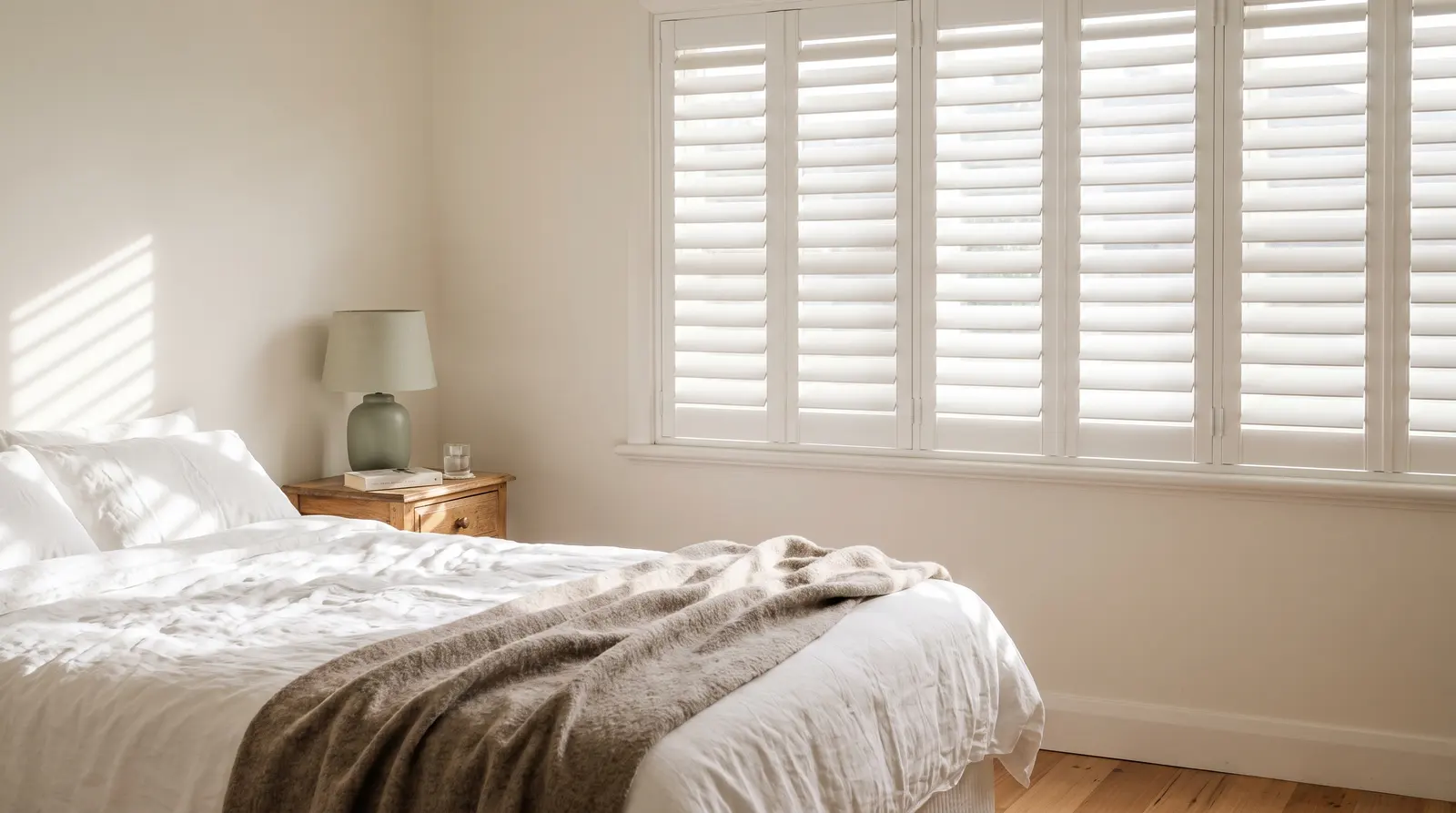
The short answer
For living rooms and open-plan spaces, timber or basswood plantation shutters with wider 63mm to 89mm louvres are the standard Adelaide choice: they frame big windows cleanly, tilt to control the harsh western sun, and suit the way one room now flows into the kitchen and dining. Budget roughly $350 to $550 per square metre for timber and $220 to $350 for PVC, with a free measured quote the only accurate figure for your exact windows.
The living room is where a shutter earns its keep. It is the most-looked-at window in the house, usually the widest, and in most Adelaide homes it faces the afternoon sun. Get it right and the whole space feels calmer, cooler and more finished. This guide covers the materials, louvre sizes and configurations that work best for lounges and open-plan zones, plus the specific things that matter in an Adelaide climate.
Why plantation shutters suit living rooms
A living-room window is a design feature, not just a gap in the wall, and plantation shutters treat it like one. Unlike blinds or curtains that stack, bunch or sag over a large span, a shutter is a fixed, made-to-measure frame that keeps its lines from the day it goes in. Tilt the louvres and you dial the light and privacy independently: open at the top for sky and view, angled at the bottom so passers-by cannot see in. That control is the reason shutters are the most requested treatment for lounges among the indoor shutters we help Adelaide homeowners specify. To sketch a budget across every window in the room before you book a measure, the room-by-room estimator runs the real price bands, and the approach carries neatly into adjoining spaces like the bedrooms covered in our light, privacy and sleep guide.
Choosing the right material and louvre size
For a living room, the two decisions that shape the look are material and louvre width. Timber and basswood are the premium pick: light, warm, and available in stains and painted finishes that read as joinery rather than a window covering. PVC (polymer) is the value choice and is genuinely hard to fault in a dry lounge, though it is heavier over very wide spans. Louvre size is where living rooms differ from smaller rooms: wider blades let more light and view through and suit the scale of a big window.
| Louvre width | Best for | Living-room verdict |
|---|---|---|
| 63mm | Standard windows, balanced look | Safe all-rounder |
| 89mm | Large windows, maximum view | The living-room favourite |
| 114mm | Very wide feature windows | Statement, fewer blades to obstruct the view |
The wider the louvre, the more uninterrupted the view when open and the cleaner the lines when shut, which is why 89mm is the most-specified size for Adelaide lounges. For a bright room that stays warm in tone, a painted basswood in a soft white or a warm neutral matches most modern and character interiors. Materials that shrug off moisture, such as PVC and aluminium, are worth saving for the wet rooms covered in our guide to kitchen and wet-area shutters rather than the lounge.
The Adelaide western-sun problem
Here is the Adelaide-specific angle most generic advice skips. A large west-facing living- room window is a heat trap. On a 40-degree Adelaide summer afternoon, an unshaded pane radiates serious heat into the room, and that is not a small thing: the Australian Government’s Your Home guide notes that up to 40 percent of a home’s heat gain in summer comes through windows. Closed plantation shutters put a solid, tiltable barrier across that glass, and the angled louvres let you bleed off harsh light while keeping some airflow. In winter the same shutters, closed at night, add a layer of insulation across the coldest surface in the room. For the bigger picture on cutting cooling costs, the Australian Government’s energy.gov.au insulation resources are a solid, independent reference. One myth worth correcting: shutters do not make a room dark and closed-in. Tilted to horizontal they flood a lounge with soft, even light, which is exactly why they suit a space you sit in all evening.
Shutters for open-plan and flowing spaces
Most newer Adelaide homes, and plenty of renovated character ones, run the living, dining and kitchen as one open zone. That flow is the whole appeal, and it is also the reason a single window treatment across the space matters. Shutters deliver a consistent material and colour from the lounge sliding door through to the dining window, so the eye reads one finished room rather than three different blind styles competing. Practical points for open-plan:
- Match the material across the zone. One timber tone (or one painted white) tying the lounge, dining and any hallway window together looks intentional and calm.
- Sliding and stacking panels for large openings. A wide glass door or a run of windows can take bi-fold or bypass shutter panels that stack aside, so you keep the indoor-outdoor flow when you want it.
- Split the tilt. A mid-rail lets you angle the top and bottom halves separately, handy when the top of a tall window catches sun the lower half does not.
- Mix materials by zone, not by room. Timber through the living and dining, then a moisture-proof material where the kitchen bench and sink sit close to a window.
The same logic runs through older homes, where deep reveals and tall sashes need a specialist eye, which our guide to shutters for heritage and character homes covers in full.
What a living room typically costs
As a working number, a standard 1.8m by 1.2m living-room window in painted basswood lands around $650 to $950 fitted, and a wide sliding-door span can run to $2,000 or more depending on the panel configuration. A whole open-plan zone with 3 to 4 large windows commonly sits between $2,500 and $5,500. Those are indicative bands: shape, access, louvre width and mount type all move the figure, and the only accurate price is a measured quote. For independent guidance on comparing home-improvement quotes and checking a trader’s licensing, South Australia’s Consumer and Business Services is a useful reference.
The bottom line
For an Adelaide living room, go timber or basswood with 89mm louvres for the view and the warmth, save the moisture-proof materials for the wet zones, and treat a west-facing window as the heat problem it is. Then get it measured. Share your living-room windows and we match you with local specialists so you can get a free quote on indoor shutters and choose with confidence, with no obligation and no call centre.