Plantation Shutters vs Curtains: Which Suits Your Home?
Shutters or curtains? Compare light control, upkeep, allergens, cost and the look for Adelaide living rooms and bedrooms.
The short answer
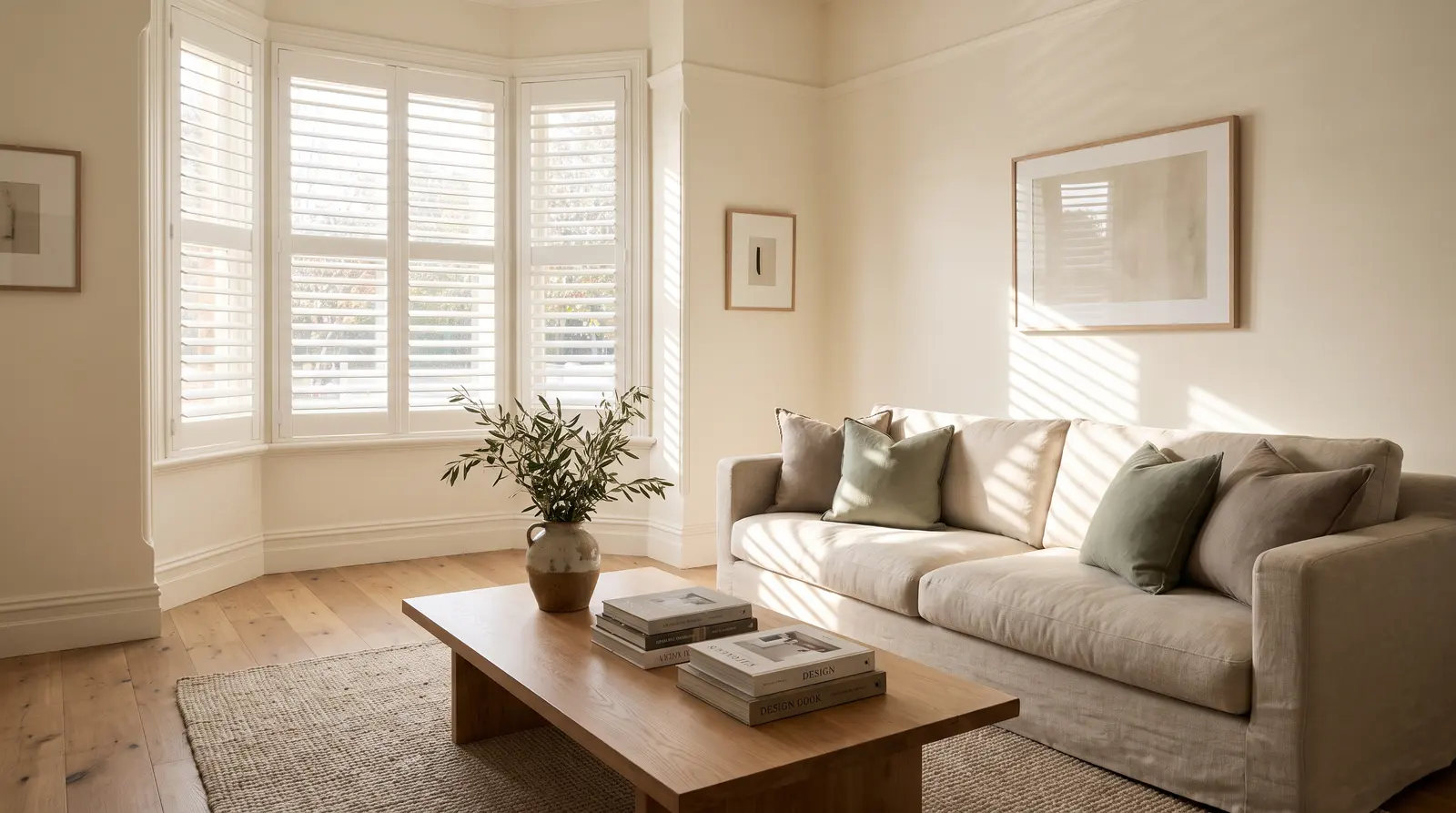
Plantation shutters suit Adelaide homes that want light control, privacy, insulation and a fixture that lasts 20 years or more, while curtains suit rooms that want softness, warmth underfoot on cold mornings, and a low upfront spend. Shutters cost far more at the start (roughly $300 to $1,000 per window against $50 to $400 for curtains) but they add to the value of the property and never need replacing when a colour trend moves on. Many Adelaide homeowners fit both: shutters on the west-facing and wet-area windows, curtains in the bedrooms.
Curtains and plantation shutters solve the same problem from opposite directions. One is soft, movable fabric you can swap in an afternoon; the other is a hard, made-to-measure fixture that becomes part of the window. Adelaide’s climate, with its 40-degree February afternoons and cold, damp July mornings, tends to reward the harder-wearing option, but the right choice depends on the room. This guide compares the two on cost, light, privacy, insulation, upkeep and resale, then shows where each one wins. If you want the fixture end of that spectrum, we connect Adelaide homeowners with local specialists for plantation shutters in Adelaide.
Cost: curtains win the day one battle, shutters win the decade
Curtains are cheaper to buy and fit. A ready-made pair with a rod can start around $50, and even good custom drapes with quality lining rarely pass $400 a window. Plantation shutters are a made-to-measure joinery product, so an indicative Adelaide range runs $300 to $600 per window for PVC, $450 to $900 for timber, and up to $1,000 for aluminium on larger openings. The only accurate figure is a free measured quote, because window size, shape and access move the number more than the material does.
The gap narrows over time. Curtains fade in Adelaide’s harsh western sun and typically get replaced every 7 to 10 years, so a home that recurtains twice can quietly spend as much as it would have on shutters that were fitted once. To size your own windows before comparing, run the shutter material selector, and if you are new to the product, our plain-English primer What Are Plantation Shutters? A Plain-English Guide explains how they are built and priced.
Light and privacy control
This is where shutters pull ahead. Adjustable louvres let you tilt for a sliver of light, full openness, or complete blackout, all while the panels stay closed for privacy. You get daylight and privacy at the same time, which curtains cannot do: with curtains you either open them (and lose privacy) or close them (and lose the light). For a full rundown of that flexibility and the insulation and resale upside, see 9 Benefits of Plantation Shutters for Adelaide Homes.
Curtains have their own answer for one specific job: true blackout. A lined blockout curtain smothers a bedroom better than any louvre, because even closed shutter blades leave hairline light lines. For a nursery or a shift worker’s bedroom, that matters. This is why the common Adelaide setup is shutters on the living, kitchen and wet-area windows and blockout curtains (or curtains layered over shutters) in the bedrooms.
Insulation and Adelaide’s climate
Windows are the weak point in a home’s thermal envelope, and Adelaide swings hard between a scorching summer and a cold, wet winter. The Australian Government’s Your Home glazing guide notes that unprotected windows can gain or lose a large share of a room’s heat, and that internal coverings with a snug fit and a sealed air gap perform best. Closed plantation shutters create exactly that: a rigid, close-fitting barrier with a trapped air layer between the blades and the glass.
Heavy lined curtains insulate well too, arguably a touch better on the coldest nights when fully drawn, but they only work when closed, which also blacks out the room. Shutters keep insulating while you still see out. On a west-facing Adelaide window that bakes from 3pm through summer, closed louvres cut the afternoon heat load without turning the room into a cave. General energy guidance from the Government’s energy efficiency resources confirms that reducing unwanted heat transfer at the window is one of the cheapest comfort wins in an existing home.
Cleaning, upkeep and durability
Shutters are the low-maintenance choice. A wipe with a damp cloth clears dust, and in a bathroom or laundry, waterproof PVC or aluminium shrugs off steam and splashes that would leave curtains damp and mould-prone. That is a real consideration in Adelaide’s older homes with small, poorly ventilated wet areas.
Curtains need regular washing or dry-cleaning, they hold dust and can trigger allergies, and in humid rooms they are a mould risk. They are, however, the easy fix if you want a new look: a curtain change is a weekend job, while a shutter is a fixture you commit to. On durability the shutter wins outright, with a well-made unit lasting 20 years or more against a curtain’s 7 to 10.
Resale value and the myth worth correcting
A myth worth correcting: plenty of homeowners assume shutters are a cost they never see again, while curtains are the safe, cheap default. It is closer to the opposite. Because plantation shutters are a fixed, made-to-measure fitting, they generally stay with the house at sale and read to buyers as a quality inclusion, the same way a good kitchen benchtop does. Curtains are chattels that often leave with the seller and rarely add a cent to the sale price.
Here is an Adelaide-specific number to sit with. Take a standard 3-bedroom home with 10 windows. Fitting mid-range shutters throughout might cost around $6,000 once, and it is done. Dressing the same 10 windows in decent custom curtains at $250 each is $2,500, but replace them twice over 20 years and you have spent $7,500 for a soft furnishing that adds nothing at resale. Over the life of the home the “expensive” option is often the cheaper one. When comparing any quotes, South Australia’s Consumer and Business Services is a useful reference on fair trading and getting quotes in writing.
So which suits your home?
Choose plantation shutters when you want precise light and privacy control together, low upkeep, genuine insulation on hot western windows, moisture resistance in wet areas, and a fixture that adds to the home. Choose curtains when you want true blackout in a bedroom, a soft acoustic feel, a low upfront spend, or the freedom to restyle a room cheaply. For most Adelaide homes the honest answer is a mix, room by room. If you are also weighing rollers, venetians or panel glides, our Plantation Shutters vs Blinds: An Honest Comparison covers that side of the decision.
The bottom line
Curtains cost less to hang and are the better call for blackout bedrooms and quick restyles. Plantation shutters cost more upfront but win on light control, privacy, insulation, upkeep, lifespan and resale, which is why they suit Adelaide’s climate and older housing stock so well. The best way to compare them fairly is with a real figure for your windows, not a range. Share your windows and get a free, no-obligation quote from local specialists for plantation shutters in Adelaide, then choose with confidence.